| Spotlight Destination |
San Miguel Allende
|
 |
| Images |
|
|
|
|
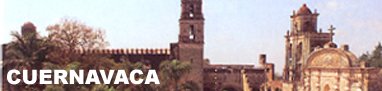
CUERNAVACA
Called the "land of eternal spring", Cuernavaca is famous for it’s spas and spiritual sites. To the east and southeast of the city are two volcanoes: Ixaccihuatl (Sleeping Woman) and Popocatepetl (Smoking Mountain).
LOCATION:
Capital of the state of Morelos, Cuernavaca is located just 64 MI south of Mexico City and 20 MI north of Taxco.
HISTORY:
The Aztecs called it Cuauhnahuac, meaning "place by the woods". This city became hunting grounds and a resort for their rulers. In 1532, after Hernan Cortes seized and destroyed the city, he ended up building himself a palace. The Spanish changed the name from Cuauhnahuac to Cuernavaca simply because they could not pronounce the former. Considered a sanctuary, the Aztec ruler Moctezuma, and colonial empire Maximilian, both built retreats here. Cuernavaca is becoming quite industrial and commercial, and with it comes traffic, crowds, and pollution.
WEATHER:
With a spring-like climate, the temperature never goes higher than 27 degrees Celsius or lower than 10 degrees Celsius. Even during the rainy season, the sun shines almost daily.
ACCOMMODATIONS:
Due to a lot of residents from Mexico City traveling to Cuernavaca, reservations for rooms are recommend for weekends and holidays. Rates range from US$18 for a single room to US$380 for a suite to US$500 for a villa. Spa and meal packages are extra. Many local families offer rooms for rent to the students attending schools.
RESTAURANTS:
Cuernavaca has many fine and expensive restaurants. Many colonial mansions were converted into restaurants, with gardens, terraces, and patios. Most eating establishments are located around the zocalo, the heart of the city. The cafes and bistros are quite popular for their coffee, drinks and pastries.
NIGHTLIFE:
In addition to tourists, locals, and students, vacationers from Mexico City make Cuernavaca come alive during the weekends. Mariachi bands wander on the corner of Plaza de Armas serenading passersby. Along the Plazuels del Zacate, people gather along the bars and cafes at nighttime. There are quite a few popular dance clubs with high cover charges. To get away from the loud music, dancing scene, and bars, Cuernavaca has a variety of cinemas and theaters. National and international music and dance performances, films with Spanish subtitles, and plays are quite popular.
SHOPPING:
In many of the markets, you will find onyx, pottery, jewelery, crystals, tiger’s eye, and quartz for sale. Bargaining for prices can be an experience all on it’s own. On the Plaza de Armas, vendors from neighboring villages sell local arts and crafts. One on side of the square, there are stalls in which you will find gold and silver jewelery, leather goods, and an assortment of other items for sale.
CUISINE:
From Mexican to Italian, Vegetarian to Hungarian, many people travel from Mexico City to Cuernavaca to dine on elaborate meals. In-season fruits and vegetables, seafood, beef, pork, and veal are some of the choices on the menu.
SERVICES:
Banks: Banks are open Monday to Friday, 9 ?6 pm, and half days on Saturdays. Money can be exchanged until 3 pm.
Internet: An internet caf?is located in La Plazuela (across from the Cortes Palace). In addition to hourly access, complete computer services and monthly plans are available.
Transportation: Due to confusing street directions and travelers from Mexico City crowding the streets with traffic, it is recommended that you use taxis to get around. Car rental outlets are located in various areas of the city.
SURROUNDING AREA:
Tepoztlan: The El Tepozteco national park is located in this picturesque little town located 24-km northeast of Cuernavaca.
Xochicalco: Mayan and Olmec ruins are located in the hills of the town, Xochicalco. Only 38-km southeast of Cuernavaca, these ruins are the most fascinating in the Morelos state.
Cuautla: This is the second largest city in Morelos. Cuautla is 42 km from Cuernavaca and is popular for it’s mineral baths. Unfortunately, the natural hot springs have not been well maintained and are more like public pools. |
| WHERE TO GO: |
Museo de Cuauhnahuac: Construction of this building began in 1522.
Over centuries, it has been modified and expanded, first by Hernan Cortes
and then by his descendants. The museum covers local archeology, history,
colonial art, weaponry, and everyday artifacts. Depicting Mexican history,
a series of murals by Diego Rivera are located in the museum.
Jardin Juarez: This small square across from the Plaza has free
bands and concerts on Thursday evenings.
Jardin Borda: (Borda Gardens) Designed in the 18th century this
large, formal garden is the most visited site in Cuernavaca. At an
artificial lake, you can rent a rowboat and row the same pond French,
Austrian, and Mexican nobility did. There is also a cafe for snacks and
drinks.
Catedral de la Asuncion: A church built in 1529, it is noted for
its skull and crossbones over the main entrance, the 17th century Japanese
wall paintings, and it’s Sunday morning mariachi masses. Paintings depict
pre-Hispanic life.
Robert Brady Museum: Ceramics, paintings, sculptures, furniture,
and tapestries can be seen in this restored colonial mansion turned
museum.
Xochicalco: Meaning "Place of Flowers" these small ruins include a
pyramid and ball court. A small solar powered museum on the same site has
a cafe bookstore, and giftshop.
Balneario Temixco: Originally a 16th century sugar plantation,
this aquatic park has 10 wading pools, 15 swimming pools, water slides,
a wave pool, and a full bar.
Casa De Maximiliano: This adobe house once belonged to Emperor
Maximilian. Today it houses the Museo de Medicina Tradicional, which
features exhibits about medicinal and religious uses of Mexican plants
and herbs.
Jungla Magica: A Mexican amusement park with water slides, a
haunted house, a small water park, a natural lake, reptile house, an
aviary, and a planetarium.
Piramide De Teopanzolco: This small Tlahuican ceremonial center
was discovered in 1910. After the Aztecs conquered the Tlahuican, they
began to build a new temple around the old one. You can climb up the
stairs to the 30-ft pyramid.
San Anton Falls: This 132-ft waterfall is a sight to see. No
matter that the waters fall into a trash filled pool, the walkways that
wind under and around the falls makes the trip worthwhile.
|
| Top |
WHERE TO EAT: |
Restaurants in Cuernavaca serve many different kinds of Morelos
specialties.  Bean tamales from Axochiapan, mole verde from Laguna de
Coatetelco, catfish tamales from Miacatlan as well as bean, rice or beef
filled tortillas are some of the items to be on the look out for.
Residents from Mexico City make the trip to Cuernavaca to dine at Las
Mananitas. Ample portions, open-air terraces, and a garden teeming with
cranes, peacocks, and flamingos and the keep this restaurant packed. The
popular dish is the Mexican plate composed of chile relleno, oven-grilled
beef, enchilada, and tamale with guacamole and refried beans.  An
inexpensive but extremely popular place to dine is La Universal.  It’s
location, it’s traditional Mexican dishes, and prices make this restaurant
a favorite among locals and tourists.  Vegetarians can dine on sumptuous
meals at Naturiza.  Cauliflower dumplings, creamed carrot soup, granola
and yogurt breakfasts are some of the dishes on the menu.  Grilled trout,
German potato salad, and Wiener schnitzel are specialties at Restaurant
Vienes.  Next door is the Los Pasteles del Vienes, a coffee/pastry shop
with an identical menu.  There are several inexpensive restaurants, caf?,
and coffee shops located around the budget lodging area. |
| Top |
| WHAT TO DO: |
Studying Spanish: Cuernavaca has a number of fine language
schools, targeted to foreigners. Lodging and classes may be quite
expensive, but you can enroll for as little as a week. Most of the
schools accept credit cards.
Golf: The most popular golf spot, at The Tabachines Golf Club
and Restaurant, is an 18-hole course designed by Percy Clifford. This
course is open for public play. Breakfast, lunch, dinner and the popular
Sunday brunch are enjoyed at the restaurant. The course at the Club de
Golf Hacienda is surrounded by more than 3,000 trees, has two lagoons,
and views of the volcanoes. This 18-hole golf course was designed by
Joe Finger.
Spas: At the Mision Del Sol Resort and Spa or the Hosteria las
Quintas, you can indulge in facials, wraps, scrubs, and a variety of
massages. At the Mision Del Sol yoga, meditation, and tai chi are also
offered.
Other Activities: Tennis courts, full gyms, pools and Jacuzzis can
be found at the more expensive hotels.
|
| Top |
| WHERE TO SHOP: |
The local handicrafts market sells items such as souvenirs, textiles,
and silver.  When tour buses arrive, many handicraft vendors sell their
wares outside the cathedral gates. Onyx, quartz, crystals, and tiger’s
eye are sold at several of the public markets around town as well as other
gifts, souvenirs, and crafts. |
| Top |
|
|
| Weekly Feature |
Aristos - Mexico City
|
|
| Images |
|
|
|